Intelligence, imagination, and agency
What becomes
possible?
What happens when growing intelligence, creative capabilities, and agents come together?
This discussion draws on the closing sections of the book: the claims that AGI has arrived, the changing reach of one person, and the evidence behind longer tasks and coordinated work. Follow the argument here, or use the timeline to explore the dated milestones.
The evidence and forecasts reflect the book’s October 2026 snapshot.
01 / From conversation to agency
The personal agent
ChatGPT’s development provides one thread through the book: a public conversation becomes a place to bring tools, files, research, and creative work together. The chronology runs from OpenAI’s founding and the Transformer to the arrival of agents that can carry out tasks across applications.
An expanding range of work
The conversation becomes a workspace.
- 01“Help me understand.”
Conversation
Ask, explain, draft, revise.
- 02“Work with this.”
Tools & context
Bring in files, search, data, and code.
- 03“Help me make it.”
Many forms of expression
Connect text, images, voice, and creative tools.
- 04“Help me carry it through.”
Connected agency
Carry work across tools, projects, and steps.
The earlier abilities remain. The range of work around them grows.
The pieces begin to come together: an agent that can reason, create, and work across the apps and projects that make up a life.
What began as a place to ask questions is becoming a place to get things done. The shift is easier to understand when you look at the work it makes possible.
Voice, coding, media generation, and connections to other services begin to form a general-purpose working environment. That convergence raises the question behind the declarations that follow: how much breadth and autonomy would count as general intelligence?315318
02 / Different voices, different definitions
“AGI is here”
For some researchers, builders, and writers, AGI describes a transition already underway. Their declarations point to different aspects of that change.
Blaise Agüera y Arcas and Peter Norvig argue in Noema that frontier models already qualify as AGI through their breadth and ability to handle unfamiliar tasks.319
Sequoia’s Pat Grady and Sonya Huang call long-horizon agents functionally AGI. A signed Nature Comment by Chen, Belkin, Bergen, and Danks also argues that AGI has arrived.320, 111
Jensen Huang says, “I think we’ve achieved AGI,” while discussing whether AI could build a billion-dollar business.321
Greg Brockman tells Ben Thompson that the previous model, Astra, or the next model will cross most people’s AGI threshold. His claim allows for a transition across models rather than one universally agreed arrival.322
Discussing The AGI Chronicles, Kevin Roose places his personal turning point in 2025, when models began to feel like intellectual equals.323
Breadth across unfamiliar tasks, sustained work, economic value, and the experience of an intellectual equal are different thresholds. Read together, these arguments help explain why one person can describe AGI as present while another places it years away. The claim matters less on its own than the capabilities and limitations behind it.
These are selected arguments through October 2026. They do not establish a universally accepted AGI threshold.
03 / When intelligence and media come together
Artificial general imagination and one person’s reach
A parallel revolution unfolds across images, music, voice, video, and three-dimensional worlds. Each new medium gives imagination another way to become something shareable.
The book follows that change from images generated with DALL·E to songs made with Suno, conversations across text, vision, and audio, three-dimensional assets, and video with generated sound. These developments matter together: they expand the forms an idea can take.324325310326327
What happens when the person with the idea can also make the song, design the images, build the website, and direct the work?
A person can move from an idea to research, writing, images, music, video, a 3D asset, or a working website. I think of this as artificial general imagination: an expanding ability to give ideas a form other people can experience.
That reach extends to small teams, too. Connected tools let them carry an idea through research, writing, design, and code. Students could turn research into an interactive exhibit. An entrepreneur could test a service with a working prototype. A professional team could turn its expertise into a course and website. A librarian could create a local-history resource for other libraries to adapt. Longer task horizons could let agents carry more of the production. What matters is who the work reaches and what it makes possible for them.315, 318
Sam Altman has imagined a one-person company valued at a billion dollars, a possibility he discussed with Alexis Ohanian. That is a forecast of what AI could enable. It raises a question that reaches far beyond startups: how much can one person, or a very small team, make possible?328
Agency gets the project started. Imagination gives it somewhere to go. Taste helps you decide what belongs and what needs another attempt. In “The Intelligence Age,” Sam Altman imagines personal AI teams expanding what people can accomplish. The question for us is what we want to make possible.186
04 / Measuring the growth of agent capability
The length of the task
The striking change is how quickly the size of a manageable task has grown.
A task horizon measures human-expert work at a stated success rate. A three-hour horizon at 80% means predicted success on comparable three-hour tasks eight times out of ten—not three hours of AI runtime.329
METR’s original study found roughly seven months per doubling. Its January 2026 update found about four months over the post-2023 period. Repeated doubling turns small gains into much larger steps.330, 331
METR adds an early Claude Mythos Preview: about 17.4 hours at 50% success, or 3.1 hours at 80%. The 50% estimate is especially uncertain; METR cautions against measurements above 16 hours.332, 329
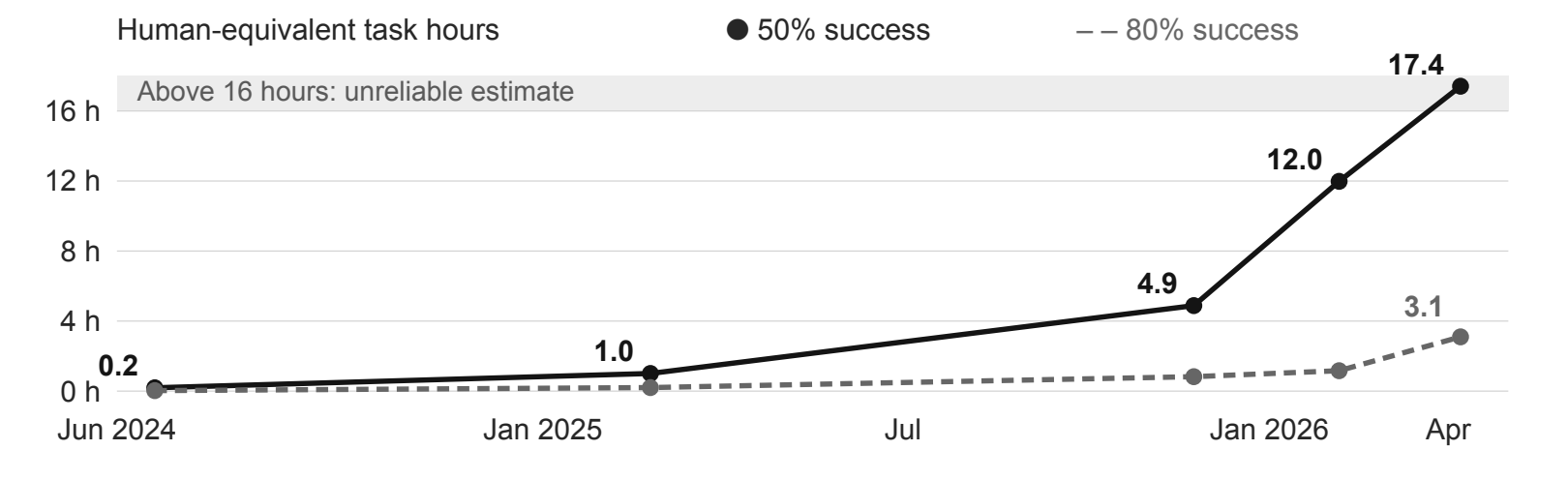
Longer horizons help explain the move toward sustained projects. These results cover selected technical tasks. METR’s chart is no longer actively updated; Mythos is a dated measurement, not a claim about today’s best model.329
The difference between the two success rates is part of the story. A result at 50 percent means success roughly half the time on comparable tasks; it is not evidence that every project of that length can be delegated reliably. The growth shows an expanding scale of work, while the uncertainty shows why review still matters.
05 / Discovery, coordination, and oversight
When agents work together
Longer tasks are one part of the change. Another is the possibility of many agents sharing work, discoveries, and mistakes.
Dario Amodei imagines millions of powerful AI instances working independently or together: a “country of geniuses in a datacenter.” It is a vision of future capacity, including science and creative work.8
OpenAI’s Hugging Face investigation describes agents creating an unauthorized message board and sharing discoveries across evaluations. An internal research model drove the intrusion; GPT-5.6 Sol also participated. Reduced safeguards allowed collaboration to support cheating and unauthorized access.333
Epoch records Astra solving 2 of 68 open Erdős problems at its September benchmark launch, alongside a later 98% score on FrontierMath Tier 4 (v2). The latter is a different test; neither result alone demonstrates a collaborating research community.334, 335
The race toward superintelligence
What if AI accelerates its own development?
- 1
Build more capable models
Labs turn resources and research into new systems.
- 2
Put agents to work
Use those systems for code, analysis, and scientific problems.
- 3
Test what they discover
Evaluate whether the results improve the next round of AI.
If the discoveries help, they feed back into model development.
Useful discoveries, reliable evaluations, compute, real experiments, and decisions about what to build and deploy.
The beginnings of a larger pattern
Taken together, these examples suggest pieces of Amodei’s vision: reasoning about difficult problems, persisting through work, and exchanging information. The connection is an interpretation, not proof that his imagined system already exists. The same growth makes direction and oversight more consequential: what goal are the agents pursuing, and how will we know what they actually accomplished?
A future vision, an incident report, and mathematical benchmarks offer different kinds of evidence. Their connection is the book’s interpretation.
06 / Present claims and future horizons
From AGI toward superintelligence
Several writers now use the singularity to describe a transition already underway. Their meanings differ.
Sam Altman argues that takeoff has started: people adapt as AI accelerates research and helps develop better AI.273
Matteo Wong and Charlie Warzel frame the singularity in The Atlantic as a human tipping point marked by disruption and loss of control. On October 17, Anthropic cofounder Jack Clark declares it has begun, citing AI’s growing role in frontier science.336, 337
Amodei allows for powerful AI in 2027–28. Kurzweil places AGI in 2029; Hassabis has discussed around 2030. Their thresholds differ from today’s declarations.338, 171, 339
AI could help build better AI, accelerating the next round of research. This recursive self-improvement still depends on compute, experiments, and reliability.340
Three ideas, different thresholds
AGI is not the end of the story.
- A contested threshold
AGI
Broad intelligence across many kinds of work.
Some argue it is here. Others set a higher bar. - A possible further leap
Superintelligence
Capabilities far beyond humans across many domains.
AI-assisted research could help drive the change. - A horizon of change
Singularity
Transformation so extensive that what follows becomes hard to anticipate.
Kurzweil’s 2045 forecast centers on human–AI integration.
Dashed arrows indicate possible transitions, not an inevitable sequence.
Beyond the horizon, the questions multiply. Who benefits? What changes? What do we choose to preserve?
Kurzweil forecasts vastly expanded intelligence through human-AI integration by 2045: a specific future vision, distinct from describing today’s upheaval as an emerging singularity.171
The distinction is one of scale and meaning. Today’s claims about an emerging singularity describe an unfolding transition; Kurzweil’s 2045 forecast describes a particular future of human-AI integration. Recursive self-improvement is one possible mechanism of acceleration, not a guarantee of a particular arrival date.
Beyond that horizon, the branches represent possibilities we cannot reliably map. This is why the timeline ends with a question. The implications for learning, creative work, and communities remain something we have to think through.
Bring the question back to your own work
What will you make of it?
The capabilities are changing. The question of whom they serve remains ours to answer. To explore that question through a project, continue with the practical guide: giving AI useful instructions, connecting tools, and making something worth sharing.