Chapter 6
The Intelligence Gap: Why AI Skills Alone Aren’t Enough
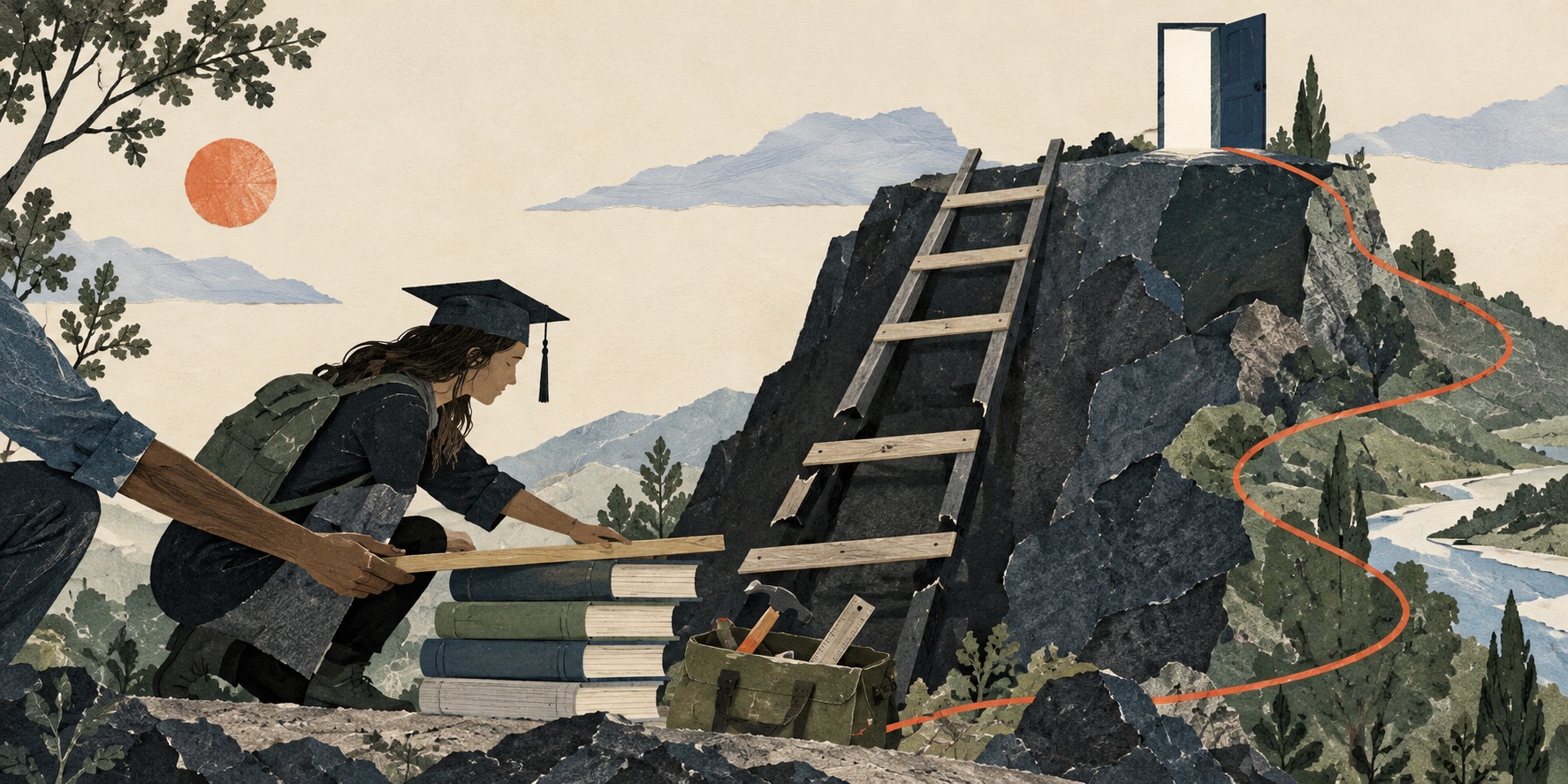
Will the “AI native” generation actually be okay? Or are we about to see the emergence of an intelligence gap wider than anything the digital age created?
I read a news story this morning about how A.I. is breaking the traditional career ladder for college graduates. The main idea is that A.I. is going to eliminate entry-level jobs, which used to be the primary way students entered the workforce.
My guess: The story is correct.
Reflecting on my first internship in the music industry, which now makes me feel about a million years old, I remember adding friends to an indie band’s MySpace page and sending those new fans a personalized message. I think we also wrote blog posts, which helped me break into writing, and pitched marketing ideas. All of that intern work is gone.
I spend a lot of time thinking about so-called “AI natives” these days. Why? I remember when I first learned in a Barnes & Noble over a decade ago that I was a “digital native.” I had no idea that my farm having a computer and dial-up internet in my K-12 years meant I was somehow different from previous generations, but I was. I’m still a very tech-savvy person, and my parents aren’t.
But what does it mean to be AI-savvy, exactly?
A lot of smart people, myself included as an academic librarian, are trying to demystify AI literacy or fluency. We’re making the case that if we teach AI natives AI literacy, they’ll be able to navigate this AI-driven world better than before. I’m starting to think that’s not enough. More accurately, I believe a divergence in approaches has already started to create an intelligence gap, or divide, which will separate AI natives who are prepared for the coming wave from those who aren’t.
I’ve heard others say that what an intern or entry-level worker used to be expected to do has simply gotten more intense or harder. That makes sense. I’ve also heard that if you can have an AI system automate this work, or augment your ability to do it yourself, why hire an intern? That’s the thinking, right? The bridge doesn’t close down, it just never opens up.
The bigger challenge is that the AI sector is currently moving at warp speed. It’s hard to quantify beyond benchmarks, but the models are getting smarter, and the agents are getting better at doing longer tasks effectively. If we fast forward to 2030, I wonder how much better the models and agents will be, and to what extent AGI—artificial general intelligence—will have been achieved. I wonder about the explosion of AI-native hardware and assistants. By then, I bet we’ll be talking about agent literacy rather than just AI literacy. I hope we’ll be able to figure out the difference between “cheating on your homework” and “hacking a system” that wasn’t keeping up with technological change.
My guess is that if the AI frontier keeps moving this quickly, it’ll be impossible for anyone to be truly AI native at anything. Even if you use these tools every day in your personal or professional life, there’s always something new to learn. However, I think the people who use ChatGPT all the time, and have explored OpenAI Academy, knowing all the capabilities of these AI systems, will be able to separate themselves from their peers.
They’ll be able to showcase their projects and skills in ways that show they’re not just AI native and leaning on skills they picked up during their undergrad program. They’ve gone above and beyond to learn how to use all of this tech, which will make them highly valuable.
The greater challenge might be that even though AI doesn’t leave the headlines, and younger people are hopefully getting the message and are trying to leverage the tools or find careers less impacted by them, there’s still going to be an inevitable intelligence gap. I believe this will manifest in a few ways.
First, using ChatGPT all the time doesn’t mean you know how to truly leverage it for co-intelligence and collaboration. You might just be offloading your work cognitively. Maybe you can churn out assignments, but you lack personal taste or a standard of quality.
Second, most people don’t have hundreds of dollars for the highest tier of ChatGPT, or the budget to subscribe to the premium tier of multiple tools and services. This will create blind spots in people’s abilities, where they might know ChatGPT but not know how to use Operator or Deep Research well.
Third, there’s the bigger challenge of how well people understand how systems or even just organizations or industries work. A student who uses ChatGPT to automate their homework isn’t learning how to strategically use AI to do the job of a professor, who might do real research. If you never get an entry-level job, you can’t gain perspective on what the work is actually like, nor get exposure to higher-level strategy. You can’t see your bosses’ workflows or how they manage the larger scope of work happening under them.
In other words, you probably can’t just give someone an agent, tell them to think big picture and strategically about how to automate their routine work, and expect them to direct that agent force like a team of employees, unless they know how to think one level above their current job.
I believe this is the larger challenge—one that goes beyond AI literacy and fluency, and whether you’re part of the AI-native generation. It’s why the intelligence gap or divide is going to widen, and it’s going to get harder to grab the first couple of rungs on any kind of career ladder. Each year, at least for the foreseeable future, will unveil changes in the kinds of work that more powerful AI systems and agents make possible, creating new jobs and destroying old ones.
Maybe the real question isn’t who is an AI native, but who can keep learning as fast as the machines themselves. In a world where the ladder keeps rising, the only way up is to climb alongside the technology, never assuming the next rung will be there.