Chapter 9
Building the Imagination Lab: A Manifesto for Libraries in the Intelligence Age
If you woke up on a university campus in 2030, you’d see the main difference before you felt it. Students aren’t “going to an AI chatbot” anymore; they’re wearing, hearing, and gesturing to always-on AI companions46 threaded through glasses, earbuds, pens, tablets, and devices we haven’t named yet.
The major platforms—OpenAI, Meta, Google, Apple, Snap, and others—are racing to ship47 AI-native hardware48 and ambient agent layers49 that move beyond typed prompts into context-aware assistance. Parallel efforts are reinventing web browsers,50 productivity suites,51 and social platforms52 around generative and agentic intelligence. We already see the outlines in 2025.
By 2030, this will be the water we all swim in.
The trouble is that access to this future is already uneven. The most capable frontier models and agent features sit behind53 premium subscriptions.
Some students (or their parents) might spring for a high-end ChatGPT tier but not the stack of specialized tools emerging around presentation, research, writing support, and voice-to-text—whether that’s Gamma,54 NotebookLM,55 Grammarly,56 or Wispr Flow,57 or next-wave discipline tools in medicine, business, and education.
As universities begin negotiating campus-level AI packages, students at well-resourced institutions58 will accumulate hours of guided use, custom-tuned models, and AI literacy education59 that compound into material advantage.
That advantage will harden into an intelligence gap layered atop the long-standing digital divide.60 First came unequal broadband. Then uneven digital literacy—the skills to find, vet, and interpret information online. Now we face a third divide:61 differential access to collaborative intelligence—the ability to work fluidly with advanced AI systems, evaluate outputs, orchestrate multi-tool workflows,62 and build domain insight faster than peers.
In a media environment thick with synthetic text, deepfakes, and automated persuasion, those without guided AI fluency will struggle not only to compete academically and professionally but also to navigate reality.
University libraries cannot afford to remain passive63 as this shift accelerates. Ensuring equitable access to journals, databases, and print collections is no longer sufficient. The instructional frontier has moved: from information literacy (find, evaluate, cite) to AI literacy64 (question, prompt, interpret) and now to AI fluency65 (collaborate, create, imagine).
As campuses head into the fall semester—with next-gen models, early general-purpose agents, and AI-native devices on the horizon—the question becomes: What if the library were the place where students and faculty learned to imagine with AI, not just use it? To remain essential in the intelligence age, libraries must become laboratories of imagination—and more.
From Information Hub to Imagination Lab
In the winter semester, I hosted AI Literacy Week66 on my own campus. I organized a faculty panel, a documentary screening, an AI art contest, and a book display, but I quickly discovered just how hard it is to get students to show up, let alone engage with abstract concepts like generative AI. What made the difference wasn’t the programming—it was a professor who invited me into their class afterward.
That single invitation unlocked the opportunity to speak to students directly, and it changed everything. These students weren’t just curious about prompting techniques or information literacy. They wanted to talk about the future. They wanted to grapple with what AI meant for their lives, their careers, and their sense of reality. That experience convinced me that what we need are not just events or tools, but spaces—labs of curiosity and imagination where these deeper conversations can take root.
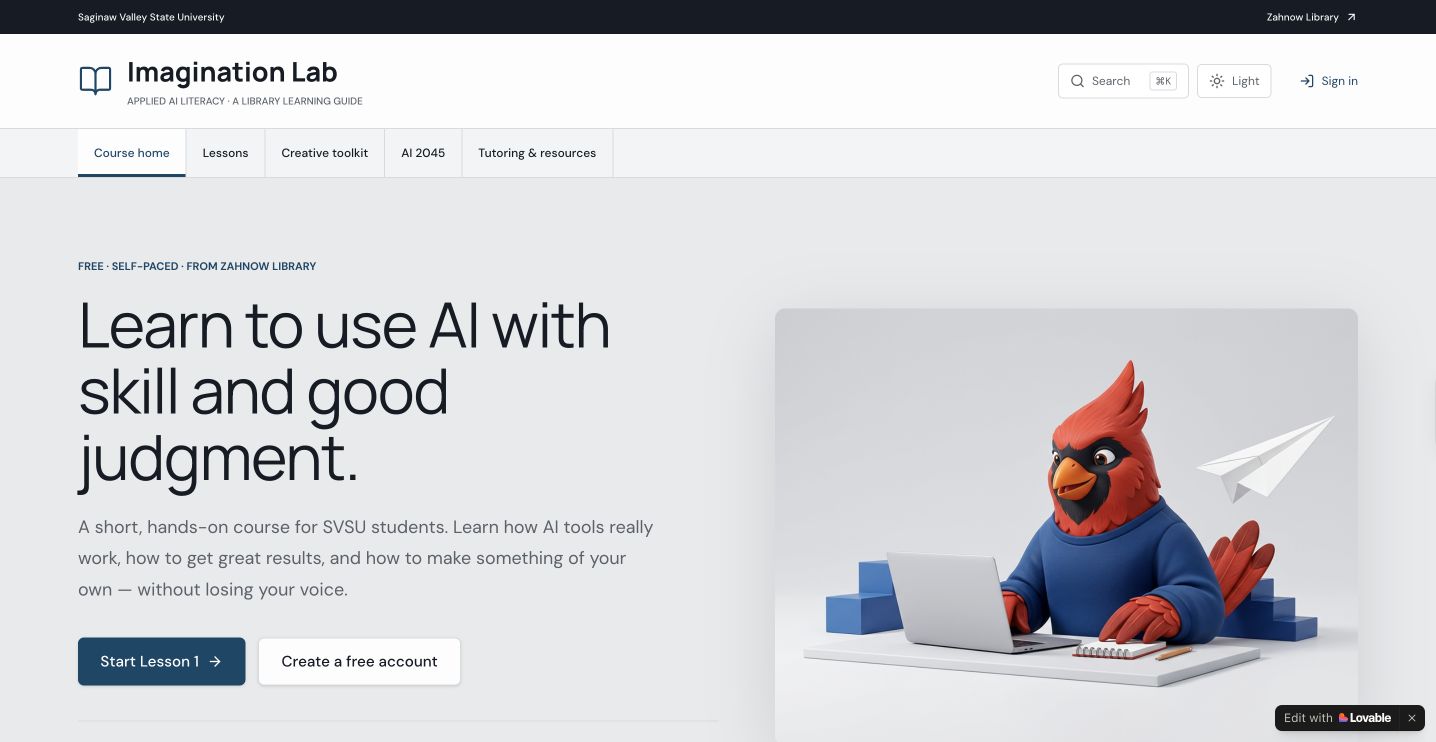
You might be wondering: What exactly is an Imagination Lab? How does it differ67 from an AI Studio, a Makerspace, or the typical emerging tech lab? In my view, an Imagination Lab is not just a room full of frontier AI tools—it’s a space designed to cultivate both fluency and imagination. It offers hands-on access to the latest generative models and services. It hosts prompt labs, agent workshops, faculty panels, and hackathons.
But beyond access and training, its true purpose is to help students and faculty learn how to collaborate with intelligence, not just consume it.
AI fluency, as I define it,4 means more than just knowing how to open ChatGPT. It’s knowing how to use it well. It’s understanding the differences between models, the capabilities of agents, and the nuances of using memory, instructions, and personalization. It’s the ability to customize tools, orchestrate workflows, and build systems that augment your work across your personal, professional, and academic life.
But this technical skill set alone isn’t enough. Fluency without imagination is sterile. Students must also learn how to translate intelligence into usable, expressive forms—how to tell stories with insight, present research with resonance, and adapt their findings to new media contexts.
You might be able to write a perfect prompt for a Deep Research report—which is a good way to start the exploration of a subject area—but what if your professor wants a deck? What if your future stakeholders need a two-minute explainer video? What if the right output is a TikTok, a podcast segment, or a stylized, shareable data visual? This is where imaginative literacy begins—knowing not just what you know, but how to communicate it creatively and strategically.
That’s why I believe the term Imagination Lab better captures the trajectory we’re on than “AI Studio” or “Emerging Tech Lab.” Generative AI is quickly becoming a creativity amplifier, not just an intelligence engine. Just look at Google’s Veo 3 video suite.68 Already, social media is filling with AI-generated short films69 starring gorillas, raccoons, and yetis narrating surreal adventures.
Within a few iterations, generative video will make it possible for any student to create a full documentary, explainer, or campaign for a class project, public initiative, or start-up launch. The implications for libraries are profound. We’re not just curating access to knowledge—we’re curating access to expression. The Imagination Lab becomes a place where students don’t just find information—they transform it.
Some campuses have already begun to build them. The University of North Carolina at Chapel Hill will launch70 an AI Studio this fall, offering a hands-on space for student experimentation and instructor support. The University of Rhode Island’s AI Lab is another early model. These initiatives are encouraging and exciting. What’s needed in the coming years is a shift toward creative, collaborative, and imaginative engagement with AI. The time to build this future is now.
The first AI lab71s are emerging. What’s needed is a movement of librarians bold enough to reimagine the future—and their role in shaping it.
What Happens Inside an Imagination Lab?
During my graduate studies at the University of Michigan, I interned at the Shapiro Design Lab,45 a creative technology space outfitted with 3D printers, laser cutters, sewing machines, button makers, recording booths, and more. I quickly learned that it’s not enough to provide emerging technologies—you need guides. Students didn’t just need to borrow equipment; they needed help imagining what was possible, troubleshooting their ideas, and adapting tools beyond their intended use.
Sometimes, they needed support that the lab wasn’t “technically” designed to provide, but the lab staff rose to meet them anyway. That’s what made it work. And it’s what an Imagination Lab must also do: create a space where creative and collaborative support is as present as the technology itself.
Step into a future Imagination Lab, and you might see rows of high-performance computers running the latest frontier models, each station fitted for everyone’s needs: deep research, design generation, agent orchestration, multimodal storytelling. But the experience wouldn’t stop at the keyboard. Instead of typing prompts, students might wear noise-canceling headsets and converse aloud with their assistants—asking, refining, iterating.
Some may wear smart glasses72 that let them summon multiple virtual displays, gesture to organize information, or bring data to life in augmented space. Picture a student with a boom mic, gesturing like a conductor, surrounded by swirling virtual monitors. It may sound like science fiction now, but the trajectory of AI-native hardware—OpenAI’s rumored device, Meta’s AR glasses, Wispr Flow, and beyond—suggests we’re closer than we think.
What role will librarians play in this space? Yes, they’ll lead workshops on AI fluency, agent customization, and multimodal storytelling. They’ll collaborate with faculty to codesign assignments, embed AI instruction into classrooms, and offer hands-on studio hours. But their role goes deeper. As agents grow more capable—drafting reports, generating videos, automating workflows—our traditional understanding of assignments will be upended.
What’s the learning assessment value of students writing a 15-page research paper if an AI can do it in a few seconds? Suffering builds character, they say. But who is reading such lengthy reports beyond Amazon bosses,73 who famously prefer written reports over flashy decks? The real value may begin to shift to higher-order thinking: crafting novel questions, synthesizing cross-domain knowledge, navigating ambiguity, and designing new systems.
The Imagination Lab becomes the place where faculty, librarians, and students cocreate new forms of inquiry, moving from completion to exploration.
This is the deeper promise of the Imagination Lab: it’s not just a place to learn AI, but a space to reimagine the world with it. If AI is going to eat the internet, the operating system, the interface—and possibly arrive embodied in robots—then our job isn’t to preserve outdated academic practices. It’s to equip people to meet the moment, ethically and effectively—collaboratively and, yes, imaginatively.
The Imagination Lab is where students begin building the skills, tools, and mindsets they’ll need to confront the unexpected. Libraries wouldn’t just teach AI, but help people envision, prototype, and prepare for the future unfolding in real time.
Building the Future, One Lab at a Time
So where do you start? Do you need a budget for smart glasses, ChatGPT subscriptions, and AI-powered headsets? Not necessarily. A Minimum Viable Lab (MVL) can begin with what most libraries already have: a few computers, a quiet room, and the willingness to experiment.
By this fall, ChatGPT 5.0 will likely74 be available with unlimited use. No one will be an expert—yet. That’s your opportunity. Start by learning what you can from OpenAI’s Academy,75 LinkedIn Learning, or Coursera. Within a few weeks, you’ll know more than most students, and you’ll be ready to guide others.4 Launch a workshop series on ChatGPT fluency.
Go further: host a speculative fiction camp where nursing students write short stories about AI in future health care scenarios. Use image models to illustrate their imagined worlds. Ask: Is this a utopia,76 dystopia,77 or protopia?78 By the time they graduate, some of those scenarios might be real.
Host AI Studio Hours.79 Not lectures—playgrounds. Invite students and faculty to cocreate. Start with a roundtable: What are you working on? Where are you stuck? What have you learned? Then let them explore. Give space for solo projects, collaborative experiments, and creative tangents. End each month with lightning talks, quick reflections on what people tried, what surprised them, and what they’re doing next. In time, the lab becomes not just a place—but a community.
One where students teach librarians, librarians teach faculty, and everyone teaches each other.
This isn’t Field of Dreams.80 You won’t build the perfect Imagination Lab on day one and have students lining up to proclaim you a visionary. But you don’t need perfection. You need a prototype and a purpose. You need to plant the idea that libraries aren’t just curators of the past, but architects of what comes next.
We’re heading into a decade81 defined by generative intelligence, autonomous agents, and exponential change. Our students will live, work, and lead in that world. If we don’t help them imagine it, someone else will. Some other university. Some other lab. Some other guide. Let it be us. Let it be librarians. You don’t need permission. You don’t need to read another white paper. You need imagination. So, choose yourself and choose your library.